
Sex Offender Checks in Bristol
The Connecticut Sex Offender Registry is the main public search channel for a Bristol address or name. It is maintained by DESPP and the Connecticut State Police under Chapter 969. The authorized search opens through a SheriffAlerts-hosted interface and requires acceptance of a disclaimer. Bristol does not keep a separate public city registry, and Connecticut has no county sheriff registry office.
Start with the state system for Connecticut detail. Use the National Sex Offender Public Website when a search must cross state, tribal, or territorial lines. NSOPW federates records supplied by participating jurisdictions; the contributing state still controls the underlying profile. Neither source is a general criminal-history database. A person can have a criminal case without a registry duty, and a registry profile answers a narrower statutory question.
Bristol Address and Radius Tools
An address route helps with awareness around a Bristol home, school route, park, or other place used by one's family. Enter a street address, choose Bristol or the appropriate ZIP code, and use the radius control offered by the live interface. Map and list tabs change how the same result set appears. Verify the current mileage choices on the registry because the interface can change.
A broad radius may bring back addresses outside Bristol. A narrow one can omit nearby points beyond its edge. Repeat the search with a name when checking a known identity, and check spelling or aliases shown on a profile. Do not infer that an empty map proves no registered person is nearby. Geocoding, update timing, restricted dissemination, and the exact search values can all affect what appears.
Run more than one careful query when the place sits near a Bristol boundary. A city search, ZIP search, and street-radius search can frame the area in different ways. Save the profile's displayed agency details and last update context if a lawful safety concern needs to be shared with police. Avoid screenshots stripped of their date or warning text, since those can circulate after the state record changes. The official live profile is the better source for current status.
How to Search Connecticut Sex Offender Registry
Use the official Connecticut registry link and read its conditions before entering search terms. Name and address searches serve different purposes. A Bristol address route centers the map on a place; a name route is better when the identity is known. Match more than a name before relying on a result, since aliases and common names can create uncertainty.
- Open the Connecticut Sex Offender Registry and accept the public-use disclaimer.
- Choose a name or address route, then enter the Bristol details known to be accurate.
- Review map or list results and compare the profile photograph, descriptors, aliases, and address.
- Open the full profile to read the registration reason, status, and verification or update information.
| Field or control | Type | Required | Use |
|---|---|---|---|
| Last name | Text | Optional by route | Starts a name search |
| First name | Text | Optional | Narrows the name results |
| Address | Text | Address route | Centers a location search |
| City | Text or dropdown | Optional | Use Bristol for city results |
| ZIP code | Text | Optional | Narrows a local area |
| Radius | Dropdown | Address route | Sets the distance around the address |
| Map or list | Tabs | No | Changes result presentation |
Bristol Registry and NSOPW
The Connecticut registry gives the state-controlled detail for a Bristol result. NSOPW is the stronger first step when someone may have moved across a state line or when the search area includes several jurisdictions. It sends a query across participating public registries, but it does not create a new federal profile that replaces Connecticut's record.
The U.S. Department of Justice NSOPW search provides that cross-border layer.
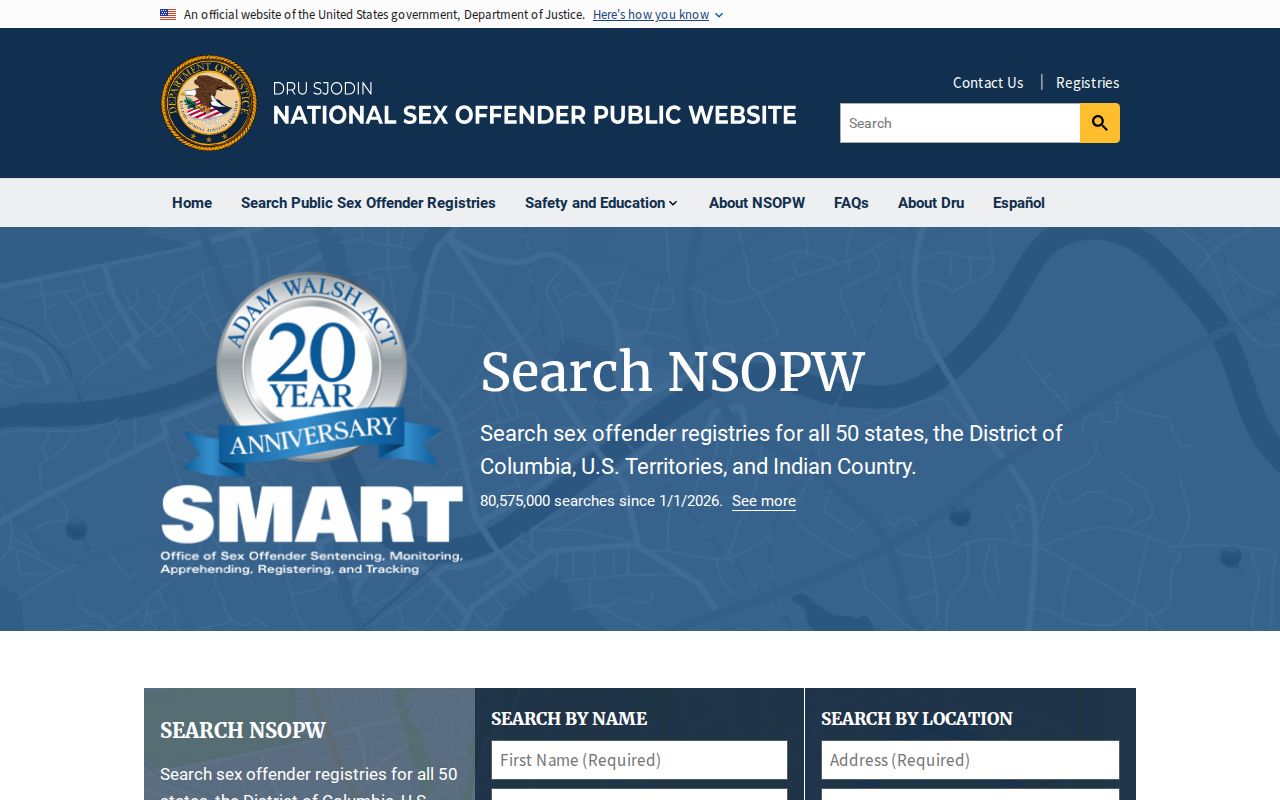
The image marks the official national route; return to the linked Connecticut profile for the state agency's current Bristol details and warnings.
Differences between the two screens can stem from data-transfer timing, how each search handles locations, or which fields the source jurisdiction publishes. Compare the profile, not just the result count. Report a suspected stale Bristol address through law enforcement rather than trying to resolve it by approaching the listed person.
Inside a Registry Profile
A public profile combines identity, location, offense, and compliance fields allowed by Connecticut law. Fields vary with the statutory route and the data available to DESPP. Treat a missing field as unknown, not as proof that the fact does not exist. Use several identifiers to confirm a match.
| Name and aliases | The displayed legal name and alternate names reported to the registry. |
|---|---|
| Photo and descriptors | A current available photograph plus physical traits, age information, scars, marks, or tattoos as lawfully shown. |
| Registered address | The residential location published under the applicable dissemination rule. |
| Offense information | The registration reason, offense, and conviction or release details provided by the agency. |
| Status | Compliance or other registration status, subject to current agency data. |
| Updates | Address verification or update information, plus vehicle data where included. |
A profile does not present a clinical risk score. It also does not state that the person has committed a new offense in Bristol. The record documents registration information tied to an earlier qualifying legal event.
Bristol Results Are Not Risk Scores
Connecticut's system is based on qualifying offenses and statutory categories. It is not a simple public Tier I, Tier II, and Tier III ranking of predicted danger. A ten-year route and a lifetime route reflect the governing offense category and statute. They should not be converted into a homemade score.
The official Connecticut registration statutes in Chapter 969 provide the legal framework.
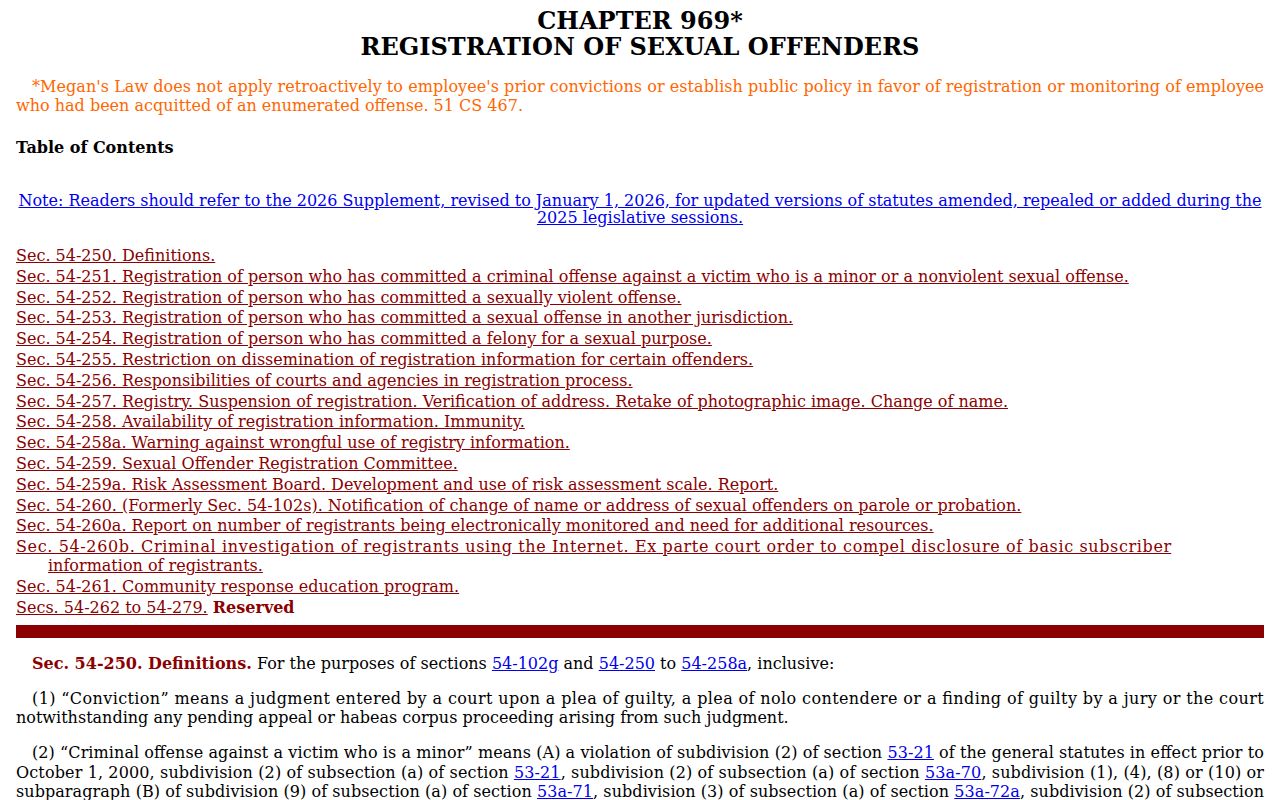
The statutory source helps explain why offense category, dates, court findings, and out-of-state duties matter more than a label borrowed from another state's tier system.
Registry status is one fact for a safety plan. Current conduct, direct threats, emergency conditions, and verified law-enforcement information require their own assessment. Call 911 for an emergency rather than treating a profile as a substitute for a police response.
Connecticut Registration Levels and Requirements
Chapter 969 sets different routes based on the qualifying conviction or finding. Exact dates and later statutory amendments can affect a duty, so the table is a general reading aid rather than a case-specific ruling. Verification and prompt reporting of required changes remain part of the duty administered by the registry and law enforcement.
| Statutory route | General period | Key point |
|---|---|---|
| §54-251 qualifying offense | Generally 10 years | Covers listed offenses against a minor and nonviolent sexual offenses, subject to exceptions |
| §54-252 sexually violent offense | Lifetime | Periodic verification applies |
| §54-253 out-of-state or federal registrant | Depends on Connecticut law and originating duty | Moving into Connecticut can trigger state registration |
| §54-254 sexual-purpose felony | Often 10 years or life as directed | A court finding controls the route |
| §54-255 restricted dissemination | Case specific | Public display may be limited while law-enforcement duties remain |
Connecticut also requires timely notice of address and other covered changes. Bristol Police may assist with compliance work, but the statewide DESPP registry remains the public lookup.
Some Bristol Data Stays Restricted
Not all registered information must appear on the public screen. Under §54-255, a court may restrict public dissemination for certain eligible people even though law-enforcement registration duties continue. That distinction matters when a known duty does not produce the profile detail a searcher expects.
Erasure also does not automatically end a sex-offender registration duty where Connecticut law says the duty survives. A person reviewing their own status should rely on court orders, DESPP instructions, and legal advice tied to the actual record. Members of the public should not try to reconstruct protected fields from social media, private databases, or contact with a household.
Report Bristol Registry Concerns
If a Bristol address seems stale or a profile suggests noncompliance, record the public profile details and the reason for concern. Report those facts to Bristol Police or the DESPP registry unit. Do not trespass, follow anyone, question neighbors as an investigator, or confront the listed person or family. Law enforcement can compare the report with information that is not public.
Use 911 for an immediate threat or emergency. For a non-emergency concern, the Bristol Police Department official channel is the local contact point. A public profile can lag after a move, and an apparent mismatch can have an innocent explanation. Reporting facts, rather than making an accusation, gives the proper agency room to verify compliance.
Include the name as displayed, the Bristol address at issue, the date viewed, and the exact public status or update field that prompted concern. Do not add rumors or claim that a new crime occurred. That focused report lets Bristol Police or DESPP check the registry duty against agency data while protecting both community safety and the integrity of the investigation.
Community Notification and Lawful Use
Registry information supports personal, family, and community awareness. It can help people identify a displayed address, understand a legal registration status, and choose reasonable safety steps. It does not authorize retaliation, public shaming, denial of ordinary services, or direct contact. A result also cannot predict whether someone will offend in the future.
Misuse is prohibited: Connecticut's registry warns that using its information to injure, harass, or commit a crime against a registrant or family can bring criminal or civil consequences.
Do not threaten, intimidate, trespass, or republish profile data to spur harassment. Preserve the context and verification date when discussing a legitimate safety issue with police. The safest use of a Bristol registry result is measured: confirm the correct person, read the full record, avoid assumptions beyond the displayed facts, and send suspected violations to the responsible agency.